The R. In R&B Collection, Vol. 1 Full Album Download UPDATED
The R. In R&B Collection, Vol. 1 Full Album Download
Given a numerical data frame of students' grades in a grade, y'all may be given the task of finding information similar what is the relative position of a particular pupil in the final exam. Or yous may also have to detect out what percent of the class failed a item component of the form.
You can use R to find the Z-Score for a given P value using the qnorm() function.
Statistical parameters such equally the p value and the zscore, also called the standard score, are largely used to make such calculations. While a statistic class sometimes teaches you how to exercise this on paper, it is important to be able to practice this quickly. R gives yous a number of functions that you tin utilise to make such calculations for a big data frame fairly speedily.
Before I dive into the coding and the methodology of how yous can find the standard score for a p value in R, I'll explain what exactly these terms mean and why you need them.
What is a P-Value?
A p-value falls between 0 and i only like the likelihood of an outcome happening, it gives the probability of a null hypothesis being valid. A naught hypothesis is a argument that suggests that there is no correlation coefficient between the two variables, it opposes the hypothesis that the 2 variables are correlated.
Equally a norm, whenever a p value of less than or equal to 0.05 is found, we say that the two variables are correlated, in other words, the probability of the null hypothesis beingness invalid is insignificantly depression. Moreover, whatsoever p-value higher than 0.05 suggests that the variables are non related in whatsoever manner.
Yous can read more about p-values and how to find them with contingency tables here.
What is a Z-Score?
Suppose you have the distribution of course grades for an exam that appears to be normal and it has a mean of 45. At present suppose the instructor is interested in knowing whether one of his best students who scored a 75 is among the top x% of the scorers. In the start, this may seem similar a boring adding, merely the zscore examination statistic makes it fairly like shooting fish in a barrel. Using the given data, the instructor tin find the standard score using the z score calculation formula. This turns your raw score into a standardized score (which can be used to summate tail probabilities for hypothesis testing).
Z= (value – mean)/ (Standard Deviation)
Using a z table, you tin obtain the respective p value examination statistic for this z score, and the p value here should tell you what the chances are for someone in the class to score more than 75 marks in terms of probability. In other words, it should tell the instructor whether a score of 75 is in the summit x% of the class or not.
In more simple terminology, the standard score tells y'all how far an observation is from the average of the data in terms of standard deviations. A z score of 1 tells you that the ascertainment is at a distance of one standard deviation towards the right from the centre. Similarly, a z score of -1 tells you lot that the observation is ane standard deviation towards the left of the center. Alternatively, a z table gives you a p value corresponding to this z score, it tells you what pct of observations lie above and below this point in that sampling distribution. Z score standardization allows you to have each population standard difference and mean, assuming they follow a normal curve, and calculate the z score for each, so that you can compare more than than 1 contained variable with a different sample size to another in a standard normal distribution, even though the original scores may exist on a dissimilar scale.
Now all this may seem like a lot of statistical assay, merely R allows you to conveniently practise this with a few lines of lawmaking. I'll now keep to show you how.
Finding a Z Score in R
Suppose you have been given a p value; this would be the percentage of observations that lie towards the left of the value that it corresponds to inside the cumulative distribution role. If, for example, your p value is 0.eighty, it would be the indicate below which 80% of the observations lie, and above information technology, 20%.
Recollect that I said y'all can discover out a corresponding p value for a z value using the z table. In order to go the other way around, i.e., find a z value for a given p value, you tin ever utilize the z table again and discover the corresponding z score.
However, R makes this simpler for you. Probably the easiest way to observe a z score for a given p value is through the use of the "qnorm()" function. Information technology takes an argument of the p value and gives the z score. Moreover, the function is used for a range of purposes, if you are interested in pursuing information scientific discipline, I encourage you to read the documentation on the "qnorm()" function as well.
# qnorm in r - role to summate z score in r > qnorm(0.75) [ane] 0.6744898 The output of the function is the z score. Its value being below 1 means that the bespeak that separates the lower 75% observations and upper 25% observations is within one standard deviation of the boilerplate, towards the right.
Conducting a Normality Test
A normality exam tells you whether the probability distribution of your information is normal, and if and then, to what extent it is normal. In simpler words, it measures the significance of the normality of your data. This is important because near of the tests that statisticians oft conduct on data require that the data follows a standard normal distribution.
At this point, it may be important to bring light to the central limit theorem which essentially says that if a data contains a sufficiently loftier number of observations, the distribution will exist normal. Nonetheless, a normality test systematically measures how normal your data is and therefore, it is necessary.
I'll be using an in-built dataset of R called "ToothGrowth", that shows data of the length of teeth of guinea pigs categorized according to the vitamins and dosage they were given.
The most normally used test for normality is the Shapiro-Wilk's test. I will plug in the column that contains the length of teeth for the pigs into to part.
# z critical value in r - testing for normality > shapiro.test(ToothGrowth$len) 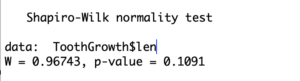
In this instance, the p value is much greater than 0.05 giving the zero hypothesis sufficient probability. Therefore, the data does not follow a strong normal distribution. You can verify the results by plotting the data yourself likewise.
# z score tutorial; checking for normality part II > ggdensity(ToothGrowth$len, principal = "Normality", xlab = "Tooth length") 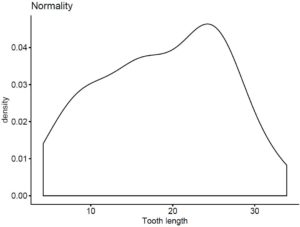
Going Deeper…
Interested in Learning More Almost Statistical Testing in R? Check Out:
- How To Create a Contingency Table in R
- How To Run A Chi Square Test in R (earlier commodity)
The Writer:
Syed Abdul Hadi is an aspiring undergrad with a swell interest in data analytics using mathematical models and data processing software. His expertise lies in predictive analysis and interactive visualization techniques. Reading, travelling and equus caballus dorsum riding are among his downtime activities. Visit him on LinkedIn for updates on his piece of work.

DOWNLOAD HERE
Posted by: boudreauxsover1961.blogspot.com

